A little over a year ago as president Trump was just getting started with swashbuckling tariff announcements and grand proclamations about how things were going to get sooo much better than before, it was easier for me to give the new administration the benefit of the doubt. That is to say, I was cautiously optimistic that the obvious problems that would likely occur in a trade war like inflation, scarcity of vital goods and increased borrowing costs could be avoided. Somehow.
Today, considering that tariff's were announced, reduced, rescinded and then announced again only to be subsequently rejected by SCOTUS combined with all hell breaking loose in the most critical energy choke point in the world, I'm am now officially cautiously pessimistic.
The only reason I say "cautiously" is because markets or rather, "markets" such as the S&P500 and Oil futures clearly don't agree with me. In fact, if I were to defer to the "markets'" reasoning on things like the future of inflation, stock prices and oil I would be dancing in the streets! The disconnect between what the "markets" say and what the fundamentals look like is staggering.

In March 2025 I wrote: "Business owners are now facing economic conditions that require them to adjust their models quickly and that's not always possible. Even when it is, there's no assurances that the conditions the adjustments were intended to address won't change suddenly once again rendering them useless."
Sudden change has become the hallmark of this current administration. For small business owners making any critical decisions about hiring, borrowing or logistics feels like a game of Whack-a-mole. Even good estimates are always guesses but when pricing of vital components or input materials like Diesel Fuel become as unstable as they are now, making plans feels like rolling dice.
"Last year, International Emergency Economic Powers Act (IEEPA) tariffs drove customs duties to historic highs, producing what looked like a windfall of tariff revenue. As we wrote then, that “windfall” was already in limbo at the Supreme Court. Now the Court has ruled, those tariffs are gone—and the administration is trying to replace them with a different emergency-style authority."

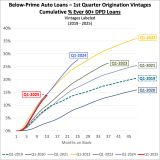
Consumer credit was already rolling over a year ago:

Now it's worse:
But hey, the straight of Hormuz will open any day, Oil will plunge, gas will be affordable again and the Dow is at a record!
Cautiously pessimistic means I know what I know but all the "smart money" disagrees so, what do I know? Well, I know that the economy relies on affordable and accessible energy. I know input costs are rising and supply is diminishing rapidly. If oil is the life's blood of the economy then we just lost 20% of our blood with no immediate prospect of it retuning. How do you suppose your body would react to losing 20% of it's blood? Would you be "better than ever"? Ready to run a 4-minute mile? Breaking personal records daily? Of course not. You (or anyone) would be putting a tourniquet on the wound to stop the bleeding and getting help asap. This is where we are right now as an economy; in need of immediate triage.
Just about two months ago, JPMorgan did the math on “How Long Before The World Hits Crude Oil Operational Minimum.” The punchline was that while the market can hold hundreds of millions of barrels, it would still become fragile once working stocks fell too low. Like blood pressure in the human body, the issue is circulation.
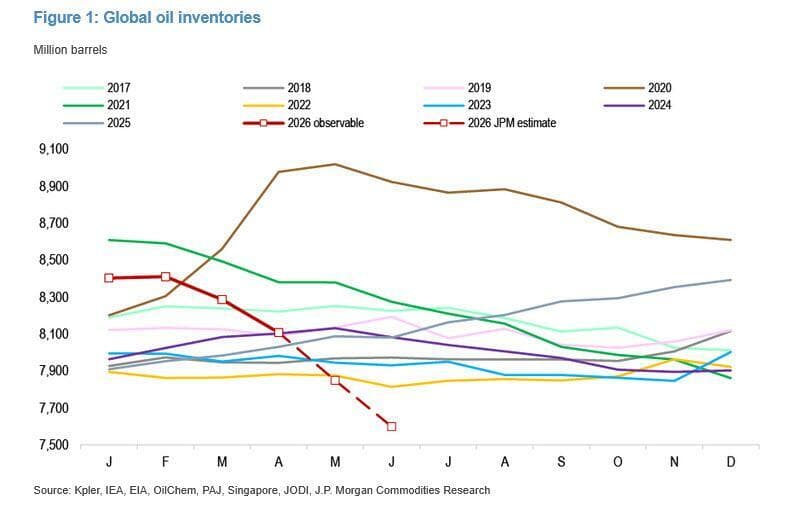
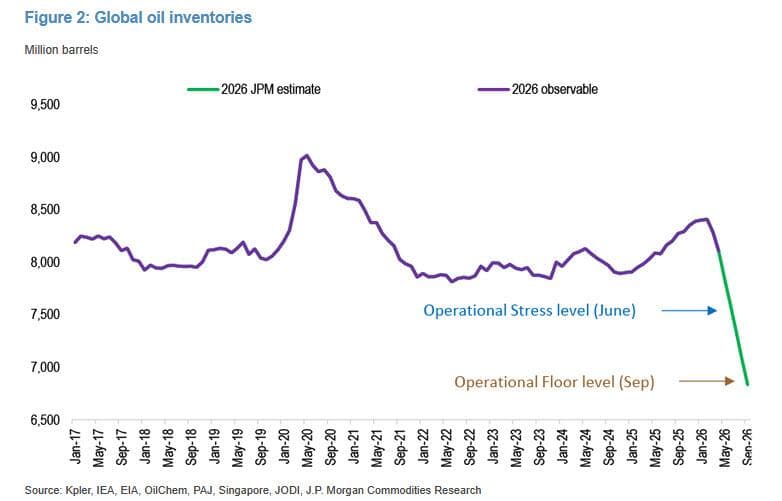
And yet, oil prices are sharply lower in May, in no small part due to the daily market jawboning manipulation by various official and unofficial sources, who signal that an Iran deal is imminent… any minute now.
Only it isn’t, and while the market may prefer to shove its head in the sand, the biggest names in the room are no longer keeping quiet.
Today, Chevron CEO Mike Wirth warned oil prices are likely to rise over the next two months as already near record low crude inventories continue to decline due to the Iran war.
“The buffers and the shock absorbers are being steadily drawn down, and the ability for the market to absorb this imbalance is drastically diminished today versus where we started,” he said at a Bernstein conference on Thursday.
Business owners are now facing economic conditions that require them to adjust their models quickly and that's not always possible. Even when it is, there's no assurances that the conditions the adjustments were intended to address won't change suddenly once again rendering them useless. There are no easy, one-size-fits-all solutions to the conditions we're in now or especially those that will be coming soon as this clusterf**k of foreign policy decisions collides like a supernova with the death star of big government and their decades of legislative overreach and abuse. There are signs that some things are headed in the right direction however timing is unknown and probably will take a lot longer that most of us prefer.
Caution is healthy; the CEO at INTEL famously said "We only survive because we're paranoid". Small business owners should consider defensive positioning right now and hope for the best. Even if the straight of Hormuz were to open up tomorrow, which is unlikely, the disruption in critical input materials like oil, Sulphur, fertilizer, helium and others are already baked in the cake.
Count on higher prices and tight supply on critical materials.
Here are some interesting articles I saw last week:
Iran’s response to the American provocation made it crystal clear that the current incarnation of the proposed 60-day ceasefire framework does not hold. China, officially, happens to support a 60-day ceasefire. Yet the U.S. for all practical purposes continues to violate the current, wobbly ceasefire.
One recent survey asked Americans if they have reduced spending in certain areas or not, and the results were absolutely shocking…
Indeed, households are feeling worse about their personal finances and the broader state of the economy than they did during the Great Inflation of the 1970s, when the cost of groceries doubled and the government was forced to ration gasoline;